Understanding The Electoral College
The Electoral College is the system the U.S. uses to choose the President.
The Electoral College is in Article II, Section 1 of the U.S. Constitution.
Why the Founding Fathers Created The Electoral College
When the United States wrote the Constitution in 1787, the leaders of the new country—known as the Founding Fathers—had to decide how to choose the President.
Some people suggested a national popular vote, where everyone in the country votes and the person with the most votes wins.
But many of the founders worried that this might create problems for such a large country with many different regions and ways of life. They knew that people in different parts of the country often had very different needs and interests. People in large cities might care more about jobs, business, and transportation. People in small towns might focus more on local schools and small businesses. People in rural farming areas might be most concerned with farming, land, and water for crops. The founders wanted a system where the President would need support from many states and regions, not just one part of the country.
They were also concerned that if elections were decided only by the total national vote, the largest population centers could end up deciding every election. They wanted people living in smaller states, rural communities, and frontier areas to still have a voice in choosing the President.
The founders were also familiar with history from Europe, where governments sometimes became unstable when power was controlled by only one group or region. For example, in countries like France before the French Revolution, many people felt the government mainly served powerful elites in major cities while ordinary people in the countryside had very little political voice. This imbalance helped lead to anger, unrest, and eventually revolution.
The Electoral College was mostly a new system created by the Founding Fathers, but it was influenced by ideas from earlier governments. In some places, such as the Holy Roman Empire, a small group of leaders called electors chose the ruler instead of the people voting directly. When the founders met in 1787 at the Constitutional Convention, they debated whether Congress should choose the President or whether there should be a direct national popular vote. The Electoral College became a compromise between these ideas. It allowed the people to vote in their states while also requiring candidates to win support from many different states and regions, not just the most populated areas of the country.
The founders also needed to balance the interests of large states and small states, since smaller states worried they would have very little influence in a national election. The founders wanted to design a system that would help balance different parts of the country and encourage candidates to win broad support across the nation, not just in a few places.
So they created the Electoral College, which requires a candidate to win support from many states across the country, not just one crowded area. The word “college” does not mean a school—it simply means a group of people chosen to do a job, in this case electors who vote for President.

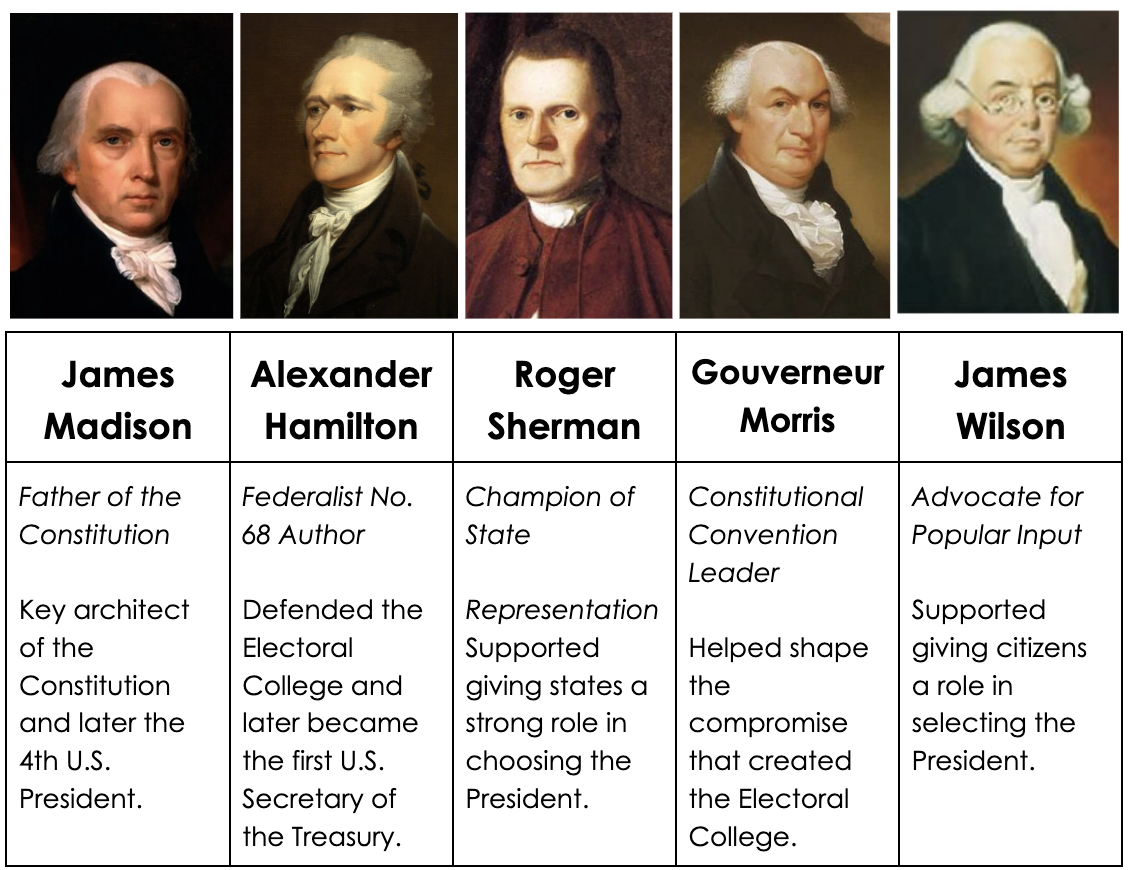
Founding Fathers Behind The Electoral College
“Talents for low intrigue, and the little arts of popularity, may alone suffice to elevate a man to the first honors in a single state; but it will require other talents, and a different kind of merit, to establish him in the esteem and confidence of the whole Union, or of so considerable a portion of it as would be necessary to make him a successful candidate for the distinguished office of President of the United States.”
— Founding Father, Alexander Hamilton, Federalist Papers No. 68 (1788)

How The Electoral College Works
The Electoral College is the system the United States uses to choose the President. Instead of the whole country counting one big national vote, each state gets a certain number of electoral votes. There are 538 total electoral votes available in the United States — 435 from the House of Representatives, 100 from the Senate, and 3 from Washington, D.C.. To win the presidency, a candidate must get at least 270 electoral votes, which is just over half of the 538 total votes.
How States Award Electoral Votes
In most states, the candidate who wins the most votes in that state wins all of that state's electoral votes. This is called the winner-take-all system. For example, if a candidate wins the most votes in Arizona, they receive all 11 of Arizona’s electoral votes, even if the election in that state was very close. Only two states — Maine and Nebraska — use a different system, where some electoral votes can be split by congressional district.
Where Electoral Votes Come From
Each state gets electoral votes based on how many members of Congress it has. There are 50 states, and each state has 2 Senators, which means 100 Senate seats total. Each state also has at least 1 member of the House of Representatives, but states with larger populations get more House districts and more representatives. There are 435 House seats total, divided among the states based on population. Altogether, with Washington D.C.’s 3 votes, that makes 538 total electoral votes.
States are divided into House districts based on population, and the goal is for each district to have about the same number of people within that state. For example, California has 2 Senators and 52 House districts, giving it 54 electoral votes. Arizona has 2 Senators and 9 House districts, giving it 11 electoral votes. The smallest population state, Wyoming, has 2 Senators and 1 House district, giving it 3 electoral votes.
Washington, D.C. is not a state, but the Twenty-Third Amendment gives it 3 electoral votes, the equivalent of the smallest states.

How House Districts Are Determined
The United States has 435 members in the House of Representatives, and these seats are divided among the states based on population. Every 10 years, the government counts how many people live in the country in a process called the Census. The results of the Census help decide how many representatives each state receives.
States with more people receive more representatives, while states with fewer people receive fewer representatives. For example, California, with about 39 million people, has 52 House districts. Texas, with about 30 million people, has 38 House districts. Wyoming, with about 580,000 people, has 1 House district.
Once a state’s number of representatives is determined, the state is divided into that many districts. Each district is drawn so it has about the same number of people, helping make representation as fair as possible. For example, Arizona has 9 representatives, so the state is divided into 9 districts, and each district elects one member of the 435-member House of Representatives.
Population changes can affect how many representatives a state has. If a state’s population grows faster than other states, it may gain additional House districts after the next Census. If a state loses people or grows more slowly, it may lose a district. Because electoral votes are based on Congress, gaining or losing House districts can also change how many electoral votes a state has in presidential elections. For example, after the 2020 Census, Texas gained 2 House seats because its population grew by about 4 million people from about 25 million to 29 million. Its electoral votes increased from 38 to 40. In contrast, California lost 1 House seat because its population grew more slowly than other states from about 37 million to 39 million. Its electoral votes decreased from 55 to 54.

Article II, Section 1: Electoral College
Summary: The Constitution originally required each state to choose electors equal to its members of Congress, and those electors would meet and vote for the President. If no candidate received a majority of electoral votes, the House of Representatives would choose the President, while the Senate would choose the Vice President if needed.
Text in the Constitution: “Each State shall appoint, in such Manner as the Legislature thereof may direct, a Number of Electors, equal to the whole Number of Senators and Representatives to which the State may be entitled in the Congress: but no Senator or Representative, or Person holding an Office of Trust or Profit under the United States, shall be appointed an Elector.
The Electors shall meet in their respective States, and vote by Ballot for two Persons, of whom one at least shall not be an Inhabitant of the same State with themselves. And they shall make a List of all the Persons voted for, and of the Number of Votes for each; which List they shall sign and certify, and transmit sealed to the Seat of the Government of the United States, directed to the President of the Senate.
The President of the Senate shall, in the Presence of the Senate and House of Representatives, open all the Certificates, and the Votes shall then be counted.
The Person having the greatest Number of Votes shall be the President, if such Number be a Majority of the whole Number of Electors appointed; and if there be more than one who have such Majority, and have an equal Number of Votes, then the House of Representatives shall immediately choose by Ballot one of them for President; and if no Person have a Majority, then from the five highest on the List the said House shall in like Manner choose the President.
But in choosing the President, the Votes shall be taken by States, the Representation from each State having one Vote; a quorum for this Purpose shall consist of a Member or Members from two-thirds of the States, and a Majority of all the States shall be necessary to a Choice.
In every Case, after the Choice of the President, the Person having the greatest Number of Votes of the Electors shall be the Vice President. But if there should remain two or more who have equal Votes, the Senate shall choose from them by Ballot the Vice President.”

Twenty-Third Amendment to the U.S. Constitution (1961)
Summary: The Twenty-Third Amendment allows Washington, D.C. to appoint electors for President and Vice President, giving it electoral votes equal to what it would have if it were a state, but no more than the smallest state.
Text in the Constitution: “Section 1. The District constituting the seat of Government of the United States shall appoint in such manner as the Congress may direct:
A number of electors of President and Vice President equal to the whole number of Senators and Representatives in Congress to which the District would be entitled if it were a State, but in no event more than the least populous State; they shall be in addition to those appointed by the States, but they shall be considered, for the purposes of the election of President and Vice President, to be electors appointed by a State; and they shall meet in the District and perform such duties as provided by the twelfth article of amendment.
Section 2. The Congress shall have power to enforce this article by appropriate legislation.”
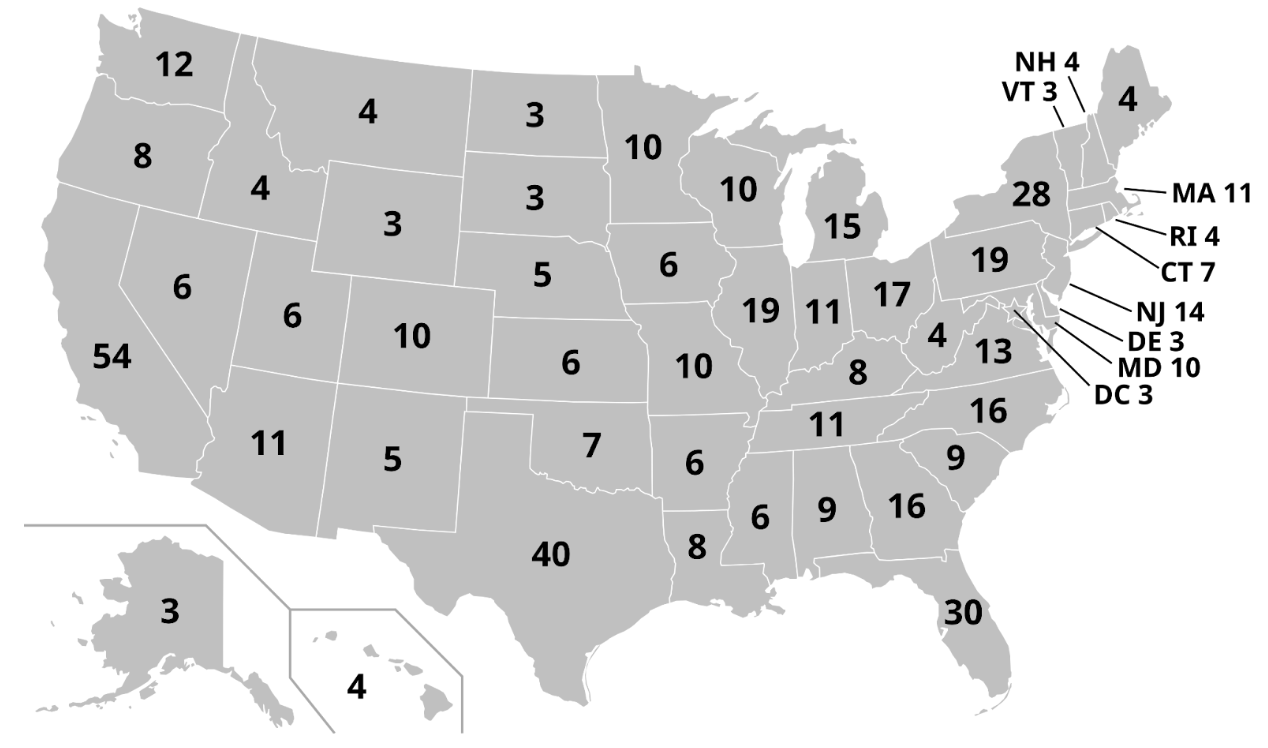
Electoral Votes based on 2020 U.S. Census
This map shows how many electoral votes each state has in a presidential election.

State Populations and Electoral Votes
Population data from the 2020 U.S. Census
Alabama — Population: 5,024,279 | Electoral Votes: 9 (2 Senators + 7 House)
Alaska — Population: 733,391 | Electoral Votes: 3 (2 Senators + 1 House)
Arizona — Population: 7,151,502 | Electoral Votes: 11 (2 Senators + 9 House)
Arkansas — Population: 3,011,524 | Electoral Votes: 6 (2 Senators + 4 House)
California — Population: 39,538,223 | Electoral Votes: 54 (2 Senators + 52 House)
Colorado — Population: 5,773,714 | Electoral Votes: 10 (2 Senators + 8 House)
Connecticut — Population: 3,605,944 | Electoral Votes: 7 (2 Senators + 5 House)
Delaware — Population: 989,948 | Electoral Votes: 3 (2 Senators + 1 House)
District of Columbia — Population: 689,545 | Electoral Votes: 3(23rd Amendment)
Florida — Population: 21,538,187 | Electoral Votes: 30 (2 Senators + 28 House)
Georgia — Population: 10,711,908 | Electoral Votes: 16 (2 Senators + 14 House)
Hawaii — Population: 1,455,271 | Electoral Votes: 4 (2 Senators + 2 House)
Idaho — Population: 1,839,106 | Electoral Votes: 4 (2 Senators + 2 House)
Illinois — Population: 12,812,508 | Electoral Votes: 19 (2 Senators + 17 House)
Indiana — Population: 6,785,528 | Electoral Votes: 11 (2 Senators + 9 House)
Iowa — Population: 3,190,369 | Electoral Votes: 6 (2 Senators + 4 House)
Kansas — Population: 2,937,880 | Electoral Votes: 6 (2 Senators + 4 House)
Kentucky — Population: 4,505,836 | Electoral Votes: 8 (2 Senators + 6 House)
Louisiana — Population: 4,657,757 | Electoral Votes: 8 (2 Senators + 6 House)
Maine — Population: 1,362,359 | Electoral Votes: 4 (2 Senators + 2 House)
Maryland — Population: 6,177,224 | Electoral Votes: 10 (2 Senators + 8 House)
Massachusetts — Population: 7,029,917 | Electoral Votes: 11 (2 Senators + 9 House)
Michigan — Population: 10,077,331 | Electoral Votes: 15 (2 Senators + 13 House)
Minnesota — Population: 5,706,494 | Electoral Votes: 10 (2 Senators + 8 House)
Mississippi — Population: 2,961,279 | Electoral Votes: 6 (2 Senators + 4 House)
Missouri — Population: 6,154,913 | Electoral Votes: 10 (2 Senators + 8 House)
Montana — Population: 1,084,225 | Electoral Votes: 4 (2 Senators + 2 House)
Nebraska — Population: 1,961,504 | Electoral Votes: 5 (2 Senators + 3 House)
Nevada — Population: 3,104,614 | Electoral Votes: 6 (2 Senators + 4 House)
New Hampshire — Population: 1,377,529 | Electoral Votes: 4 (2 Senators + 2 House)
New Jersey — Population: 9,288,994 | Electoral Votes: 14 (2 Senators + 12 House)
New Mexico — Population: 2,117,522 | Electoral Votes: 5 (2 Senators + 3 House)
New York — Population: 20,201,249 | Electoral Votes: 28 (2 Senators + 26 House)
North Carolina — Population: 10,439,388 | Electoral Votes: 16 (2 Senators + 14 House)
North Dakota — Population: 779,094 | Electoral Votes: 3 (2 Senators + 1 House)
Ohio — Population: 11,799,448 | Electoral Votes: 17 (2 Senators + 15 House)
Oklahoma — Population: 3,959,353 | Electoral Votes: 7 (2 Senators + 5 House)
Oregon — Population: 4,237,256 | Electoral Votes: 8 (2 Senators + 6 House)
Pennsylvania — Population: 13,002,700 | Electoral Votes: 19 (2 Senators + 17 House)
RhodeIsland — Population: 1,097,379 | Electoral Votes: 4 (2 Senators + 2 House)
SouthCarolina — Population: 5,118,425 | Electoral Votes: 9 (2 Senators + 7 House)
SouthDakota — Population: 886,667 | Electoral Votes: 3 (2 Senators + 1 House)
Tennessee — Population: 6,910,840 | Electoral Votes: 11 (2 Senators + 9 House)
Texas — Population: 29,145,505 | Electoral Votes: 40 (2 Senators + 38 House)
Utah — Population: 3,271,616 | Electoral Votes: 6 (2 Senators + 4 House)
Vermont — Population: 643,077 | Electoral Votes: 3 (2 Senators + 1 House)
Virginia — Population: 8,631,393 | Electoral Votes: 13 (2 Senators + 11 House)
Washington — Population: 7,705,281 | Electoral Votes: 12 (2 Senators + 10 House)
WestVirginia — Population: 1,793,716 | Electoral Votes: 4 (2 Senators + 2 House)
Wisconsin — Population: 5,893,718 | Electoral Votes: 10 (2 Senators + 8 House)
Wyoming — Population: 576,851 | Electoral Votes: 3 (2 Senators + 1 House)

Electoral College Interesting Facts
1. The Only Unanimous Electoral College Victory
In 1789, George Washington received every electoral vote, the only president ever to win unanimously.
2. A Near Electoral College Sweep
In the 1984 presidential election, Ronald Reagan won 49 out of 50 states, earning 525 electoral votes. The only state he did not win was Minnesota, along with the District of Columbia.
3. The Largest Electoral College Victory
The biggest Electoral College win happened in 1936, when Franklin D. Roosevelt won 523 of 531 electoral votes.
4. Winning Without the Popular Vote
A candidate can win the presidency without winning the national popular vote. This has happened five times in U.S. history, most recently in 2016.
5. Maine and Nebraska Do It Differently
Most states give all electoral votes to the statewide winner, but Maine and Nebraska split some votes by congressional district.
6. The Closest Electoral College Election
In 1876, Rutherford B. Hayes won the presidency by just one electoral vote, 185 to 184.
7. Electoral Votes Have Changed Over Time
When the country began in 1789, there were only 69 electoral votes. Today there are 538.
8. The Election That Tied
In 1800, Thomas Jefferson and Aaron Burr received the same number of electoral votes, creating a tie. The House of Representatives had to vote 36 times before choosing Jefferson as President.
9. The Electoral College Almost Tied in 2000
In the 2000 election, George W. Bush won 271 electoral votes, only one more than the 270 needed to win.
10. The Only Election Decided by the House (After the 12th Amendment)
In 1824, no candidate won a majority of electoral votes, so the House of Representatives chose the President. John Quincy Adams was selected even though Andrew Jackson had won more popular and electoral votes.